
The Electro-Thermal All-in-One: Why the Cazzaniga Process is a Masterclass in Process Simplicity
If you walk into a modern wire galvanizing facility today, you are usually greeted by a sprawling footprint of heavy machinery. Acid pickling tanks venting fumes, flux stages, pre-heaters, drying ovens, and a massive gas-fired zinc kettle eating up square metres of floor space. It is a high-overhead, high-maintenance beast.
But if you talk to the old-timers who were running shop floors in the mid-to-late 20th century, they'll tell you about a legendary, compact Italian innovation that made modern multi-stage lines look incredibly bloated.
They'll tell you about the Cazzaniga Process. Even as we push through 2026, the elegant physics behind this legacy hot-dip method still offer profound lessons for any plant manager trying to design a leaner, cleaner, and more energy-efficient operation.
The Scenario: The Ultimate "Three-in-One" Circuit
Imagine a galvanizing line where the wire itself is the heating element. That is the core magic of Cazzaniga.
Instead of a long, toxic journey through hydrochloric acid, the raw wire enters a single, compact tank filled with a sodium hydroxide (caustic soda) solution. Each reel of wire has its own compartment and winding reel connected to a power supply. The electrical circuit is completed directly through the wire as it travels into the molten zinc bath.
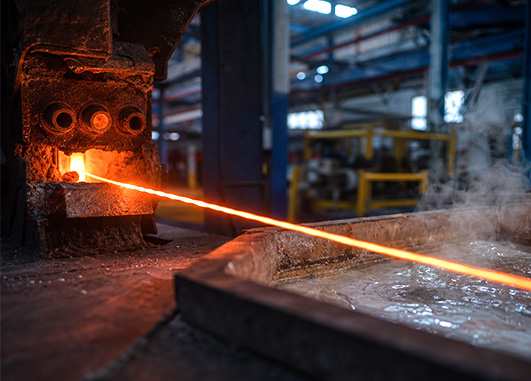
As current surges through the steel wire, two things happen simultaneously: the electric field aggressively strips away lubricants and surface oxides in the alkaline bath, while the electrical resistance heats the wire inline to its critical annealing temperature of 650–700°C. The wire then travels a mere 20 cm through open air before plunging into the molten zinc — protected during that brief gap by a sleeve of molten soda carried from the pickling bath.
Connecting the Dots: From the Zinc Bath to High-Voltage Protection
Look at a high-quality cross-section of a high-voltage power cable — the kind used to connect offshore wind farms or heavy industrial grids. Surrounding those insulated copper conductors is a heavy armour of galvanized steel wire. That steel skin must be flawless; any pinholes or brittle spots in the zinc coating mean moisture gets in, the armour rusts, and the multi-million-rand cable fails underground.
The Cazzaniga process was designed to produce exactly this kind of ultra-reliable, heavily coated galvanized wire. Because the pickling bath is alkaline (sodium hydroxide) rather than acidic, it completely eliminates the risk of hydrogen embrittlement — the silent killer of high-tensile armoring wire that we deal with in conventional acid lines.
The Modern 2026 Verdict: Is It Still Relatable?
In brand-new, mega-scale greenfield plants, the classic Cazzaniga lines have mostly been retired. High-speed multi-wire lines drawing 40+ strands simultaneously at speeds exceeding 200 metres per minute require massive, continuous furnace arrays that are easier to monitor with automated sensors.
However, the philosophy of the Cazzaniga process is undergoing a massive resurgence in 2026. As global energy costs fluctuate and the push for "green-steel" carbon neutrality intensifies, the industry is looking back at how Cazzaniga utilised direct resistance heating.
Because the wire carries its own heat directly into the zinc kettle, the wire itself maintains the bath temperature. At high production rates, you actually have to cool the zinc rather than heat it. The thermal efficiency of this design is practically unmatched by modern gas-fired burners — and that is a lesson no plant manager in 2026 can afford to ignore.
The Performance Trade-Off: Pros and Cons
The Pros:
- Unmatched Thermal Efficiency: Virtually zero wasted heat. The wire anneals itself and heats the zinc bath simultaneously — a closed-loop energy system that modern gas burners cannot replicate.
- Zero Hydrogen Embrittlement: No acid pickling means no trapped atomic hydrogen, fully protecting the mechanical integrity of high-tensile armoring and spring wire.
- Incredibly Compact Footprint: By combining degreasing, pickling, annealing, and fluxing into a single continuous electric cycle, you recover massive amounts of factory floor space.
The Cons:
- Maintenance Complexity: Managing individual electrical contacts and winding reels for multiple parallel strands can be a mechanical headache — especially on older installations without modern sensor arrays.
- Speed Limits: While speeds of up to 150 metres per minute are highly respectable, modern continuous electro-galvanizing lines can outrun it on ultra-fine wire gauges.
The Bottom Line on Process Simplicity
Whether you are running a legacy line or designing the automated plant of tomorrow, the Cazzaniga process teaches us that sometimes the most complex engineering problems are best solved by simplifying the physics.
By turning the wire itself into the electrical conduit, Cazzaniga proved that clean, high-strength galvanizing doesn't require a massive factory footprint — just a little spark of genius. In an era of rising energy costs and tightening ESG targets, that is a lesson worth revisiting.