
Trading a Lead Bath for a Fluidised Bed
If you've spent thirty years in a wire shop, you know the "Lead Bath Stare." It's that look a maintenance tech gives you when the patenting line goes down and someone has to deal with the molten, toxic, 500°C sludge. For decades, lead was the undisputed king of heat treatment. It was heavy, it was stable, and it did the job.
But as we move deeper into 2026, "doing the job" isn't enough anymore. Between tightening ESG (Environmental, Social, and Governance) regulations and the sheer cost of energy, the dated lead baths are starting to feel like the anchors that are holding us back.
Lately, the industry focus has shifted to the "Sand Dance" – the Fluidised Bed.
How the Fluidised Bed Works
Think about the traditional patenting process. You're trying to get that perfect fine-pearlite (sorbite) structure. You need to hit the isothermal "sweet spot" on the TTT curve (Time-Temperature-Transformation) without the wire overshooting or cooling too slowly.
In a fluidised bed, we take a container of fine particles – usually cecan sand or aluminium oxide – and blast air from a diffusing chamber through a mesh screen at the bottom. Suddenly, that solid sand starts behaving like a liquid. It "boils." When you run your strands through that bed, the wires are totally surrounded by these suspended, moving particles.
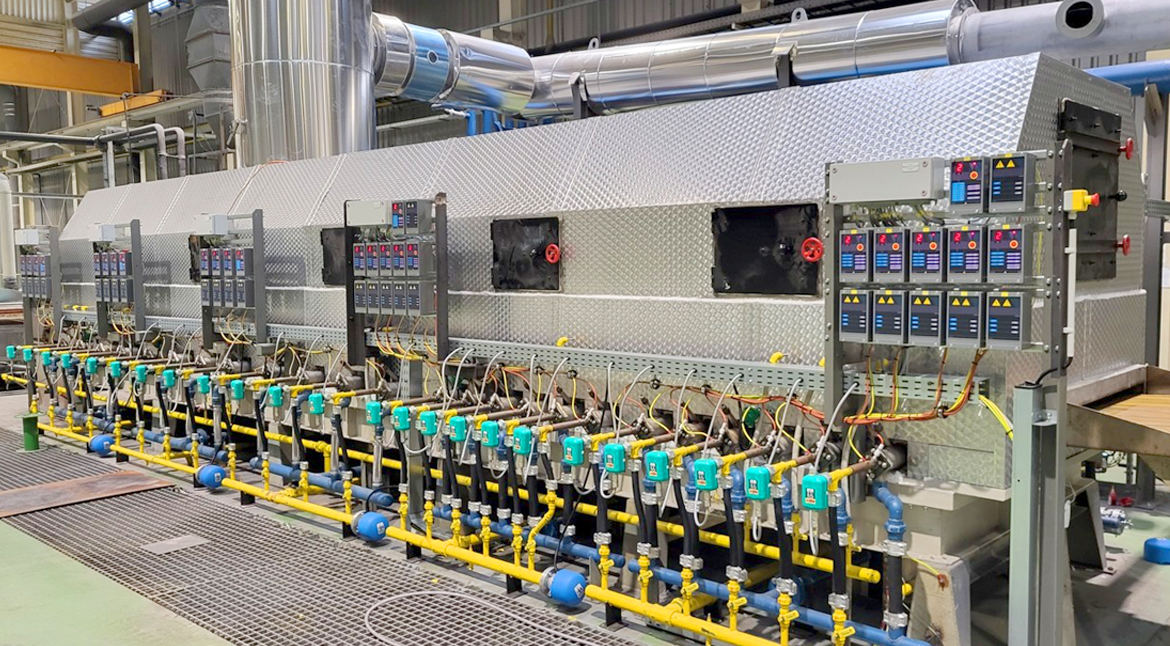
The "Lead-Free" Throughput
The jump in efficiency is where the story gets interesting. On a modern gas-fired, high-temperature bed, we aren't just matching lead; we're often outrunning it.
I'm currently looking at setups that can handle 50 wires of 1.6mm diameter humming through the bed at 0.85 metres per second. When you do the math on that kind of throughput, the legacy lead baths start to look very slow and very expensive.
Modern Lines vs. Legacy Stalwarts: Does the Method Still Apply?
A common question in global manufacturing is whether this technology still holds weight in the era of high-speed, computer-controlled mills.
On Modern Lines: The fluidised bed principle has evolved into sophisticated high-temperature gas-fired systems. Here, the process is precisely metered through high-velocity diffusers to dictate the exact cooling curve. This allows operators to produce specialised grades with specific microstructures like fine pearlite (sorbite).
On Legacy Lines: For older wire shops that haven't undergone multi-million-rand modernisations, the fundamental fluidised bed method remains the most viable upgrade path against lead-bath dependency. In these environments, the controlled air-based process keeps the line competitive while shedding the toxic burden of the 20th century.
Ups and Downs to Consider
The Pros:
- Environment & Safety: This is the big one. No lead fumes, no hazardous waste disposal, and no "lead-skin" health checks for the crew. It's a cleaner, "green-steel" compliant shop floor.
- Rapid Heat Transfer: Because the particles are in constant motion, they strip the heat away from the wire (or add it) with incredible uniformity. No "hot spots" or "piston flow" lag that you sometimes get in water-based cooling.
- Startup Agility: Unlike a lead bath that takes forever to reach temp and can't be easily shut down, a fluidised bed can be brought to operational temperature quickly.
The Cons:
- Atmosphere Control: You have to be careful with scale formation. Unlike lead, which naturally "seals" the wire from oxygen, a fluidised bed uses air. You need tight control over your gas-air mixture to ensure you aren't producing a rod that's going to chew through your drawing dies later.
- Particle Carry-over: Sand is abrasive. If your "air wipe" at the exit isn't perfectly calibrated, you'll carry particles into the next stage of the line, and that's a recipe for a maintenance nightmare.
The Impact on Operational Resilience and Yield Integrity
Moving to fluidised technology is about more than just being "eco-friendly." It's about Yield Integrity. In a lead bath, if a wire snaps, you're fishing in a toxic pond. In a fluidised bed, the accessibility and the ability to run 25 to 50 strands in parallel with high-precision gas firing means your "uptime" is actually protected.
We aren't just treating metal anymore; we're managing a high-speed thermodynamic dance. For those of us still running legacy lines, the fluidised bed is the most logical upgrade path to keep our processing speeds competitive without the "toxic tax" of the 20th century.