
When the Wire Starts "Sucking": A Floor Manager's Guide
If you've spent more than a week running a continuous drawing line, you've probably had a moment where you looked at a finished coil, looked at your micrometre, and did a double-take.
The die in the final block is stamped a perfect 2.00mm. But the wire coming off the capstan is measuring 1.95mm.
To an outsider, it looks like a miracle — we're magically getting more length out of less steel. But to any seasoned hand on the shop floor, that undersized wire is a flashing red light. Your line is "sucking" — or as the die room guys call it, "sucking down."
It's one of the most deceptive, frustrating mechanical defects in cold drawing, and even here in 2026, with our high-speed automated lines and PLCs, it's still a constant threat to process integrity.
The Physics: Steel Acting Like Taffy
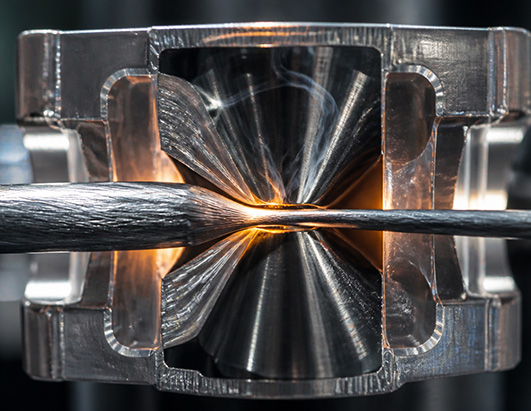
Normally, when you pull wire through a tungsten carbide or diamond die, the die orifice dictates the final diameter. But "sucking" occurs when the drawing tension between the die exit and the take-up block exceeds the actual yield strength of the wire at that exact moment.
Instead of just sliding through, the wire behaves like a warm piece of taffy. It begins to "neck" and stretch after it leaves the reduction zone but before it settles onto the capstan. In effect, the wire is starting to break. However, because the metal work-hardens as it stretches, its tensile strength increases just enough to stop it from snapping completely. The "neck" is transferred back toward the die in a steady, continuous progression — leaving you with an entire spool of wire that is uniformly smaller than the die it just passed through.
If you measure the load causing this suck-down, you'll find the yield stress at the die exit is sitting dangerously close — about 85% — to the stable breaking strength of your wire. You are running on a razor's edge.
Why We're Still Fighting This in 2026
You might think modern machinery would have designed this problem out of existence. But as we push line speeds faster to hit tighter OEE targets, the window for error shrinks to zero.
The physics haven't changed. The die exit is still the most mechanically vulnerable point on the entire drawing line. What has changed is our tolerance for defects — and in a 2026 market where high-voltage armoring wire, spring steel, and precision fastener stock must hit exact tensile profiles, a suck-down defect doesn't just fail QC. It writes off the entire spool.
When a Line Starts Sucking Down — Stop the Block
The first rule when suck-down appears is simple: stop the block and investigate before running another metre of wire.
Every second of continued production on a sucking line is compounding your yield loss. The problem does not self-correct. And unlike some drawing defects that only affect the surface, suck-down alters the fundamental cross-sectional area and tensile profile of the wire — damage that cannot be reworked or recovered downstream.
When you stop the block, you are looking for one of four root causes. Each one has a specific fix, and understanding which culprit you are dealing with determines how fast you can recover the line.
The Four Culprits: Check These First
1. Die Room Shortcuts — Excessive Bearing Length
This is the number one offender. When dies are recut to save on tooling costs, if the die room doesn't properly polish and back-relief the insert, you end up with an excessively long bearing. A bearing zone that is too long creates massive frictional drag — requiring immense horsepower to draw the wire and driving up tension until the wire simply can't hold its shape at the exit.
2. Lubrication Failure — The Boundary Film Breaks Down
If your dry soap powder is channelling in the die box, or if your wet emulsion concentration has drifted too low, the boundary lubrication film breaks down. Metal-on-metal contact creates extreme localised heat. That thermal spike softens the steel wire just as it exits the die, making it incredibly easy to stretch under the pull of the capstan.
3. Being Greedy with the Draft — Over-Reduction
Trying to take too heavy a reduction of area in a single draft — typically exceeding 18% to 22% for high-carbon steel — is asking for trouble. If the draft is too heavy, the drawing forces will inevitably spike past that critical 85% yield limit at the exit throat.
4. Bad Geometry — Steep Drawing Angles
If your die's approach angle is too steep, the metal is forced to deform too abruptly. Instead of flowing smoothly, the steel builds up a "dead-metal zone" at the die face, setting up massive resistance to easy cold flow — and a direct path to suck-down.
The Manager's Verdict on Process Integrity
In 2026, we can't afford to run undersized wire. If that wire is destined for high-voltage armoring, spring manufacturing, or mechanical fasteners, a suck-down defect completely ruins the tensile profile and roundness of the product.
Here is how we stop it:
- Audit your recut dies: Ensure your die shop is blending the bearing-to-angle intersections and keeping bearing lengths optimised. A bad recut die is the fastest route to a sucking line.
- Keep your drawing speeds stable: Sudden acceleration spikes create transient tension loads that trigger localised necking. Ramp speeds gradually and monitor exit tension continuously.
- Trust high-performance lubrication: The cost of premium lubricants is nothing compared to the yield lost from a string of broken passes or out-of-spec spools. Check your concentration and flow rates at every shift change.