
From Heavy Grease to Copper Shield: The Unsung Chemistry of Fine Wire Wet Drawing
If you've ever managed a fine wire department, you know that transitioning from intermediate drawing to high-speed wet drawing is where line efficiency is made or lost.
In the early reduction passes, heavy grease is your best friend. It gives you the high-film strength needed to pull bright, hard-drawn wire down through coarse drafts. But once you reach the fine wire stage, that same heavy grease becomes your worst enemy. If even a trace of heavy grease enters a high-speed wet drawing machine, it contaminates your liquid emulsions, clogs capstan recirculation channels, and causes immediate wire slippage or tension snaps.
So, how do you strip a stubborn, heavy grease film while simultaneously preparing the wire surface for ultra-fine reduction passes? You do it with one of the most elegant, double-duty chemical steps in wire metallurgy: the copper-flashing pickling dip.
The Two-in-One Solution: Degreasing and Copper Immersion
In traditional fine wire processing, the transition relies on a specialized acid dip that accomplishes two critical jobs in a single immersion step:
- Grease Stripping: A controlled sulfuric acid bath breaks down and floats off the residual grease film left over from the bright drawing stage.
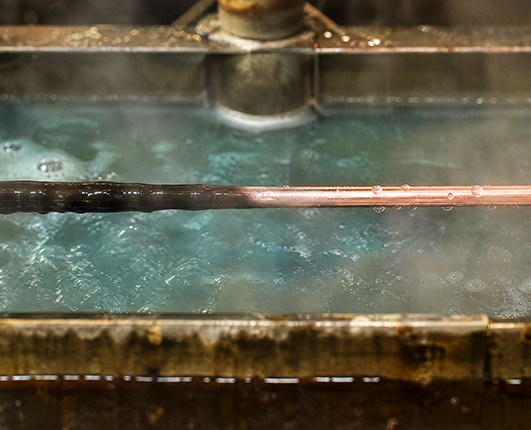
- Displacement Copper Coating: By adding copper sulphate into the acid bath, a natural electrochemical displacement reaction occurs the moment the bare steel touches the solution.
As the acid mildly etches the steel surface, iron atoms dissolve into the bath, releasing electrons. Copper ions in the solution immediately take those electrons and plate out onto the steel surface. In seconds, the wire emerges with a thin, ductile, rose-gold layer of copper – acting as a solid metallic lubricant and an ideal bonding surface for subsequent wet drawing emulsions.
The Floor Manager's Secret: The Role of Iron Sulphate
Every experienced chemical bath operator knows that a pure sulfuric acid and copper sulphate bath can be notoriously temperament-driven. If the displacement reaction happens too fast, the copper deposits in loose, coarse grains that flake off inside your drawing dies – leaving you with bare steel and high friction.
This is where the addition of 1% to 3% iron sulphate becomes the secret weapon on the floor:
- Buffer Action: Iron sulphate acts as a reaction regulator. It slows down the aggressive displacement rate, forcing the copper atoms to deposit tightly and uniformly against the steel grain structure.
- Coating Ductility: Instead of a brittle, powdery copper shell, you get a smooth, malleable metallic film that deforms with the wire as it travels through high-speed diamond or carbide dies.
Does This Process Still Matter in 2026?
While modern plants producing ultra-fine stainless steel or specialty wire often utilise continuous inline electro-cleaning or ultrasonic degreasing, immersion copper flashing remains a staple across global wire mills.
For high-carbon spring wire, hose reinforcement wire, and tire cord manufacturing, chemical copper flashing provides a cost-effective, high-throughput method to convert bright-drawn wire into a wet-drawing-ready product – without requiring multi-million-dollar electroplating installations.
By managing bath chemistry, controlling free acidity, and maintaining proper iron sulphate buffering, plant operators protect their die tooling and guarantee the surface integrity required for high-speed wet drawing.
The Pitfall: The Dreaded "Grey Wire"
When the bath goes out of balance, the floor knows it immediately. The most common quality failure is the appearance of "grey wire." Instead of a bright, reddish-copper lustre, the wire exits the dip looking dull, dark, and slate-grey.
There are two primary culprits:
- Excessive Free Acidity: If the acid concentration is driven too high, the chemical attack on the iron outpaces the copper deposition rate. The rapid release of hydrogen gas disrupts the coating, trapping iron oxides and sludge inside the copper layer.
- Bath Contamination (Dirty Dip): As thousands of metres of wire pass through the bath, residual grease sludge and dissolved iron build up. If the bath isn't regularly skimmed and de-sludged, the suspended particulates embed themselves into the fresh copper coat.
Grey wire lacks the lubricity of a clean copper coat. When drawn wet, that loose, grey layer strips off in the first die – clogging the die land and causing rapid capstan scoring and frequent wire breaks.
Protecting Your Die Tooling from the Inside Out
The copper-flashing pickling dip is proof that the most powerful solutions on the factory floor are often the most chemically elegant. One dip tank. Two critical functions. A clean, ductile copper surface that keeps your dies running longer, your emulsions cleaner, and your wet drawing speeds higher.
Manage your bath chemistry, respect your iron sulphate buffer, and never let a grey wire run past the first die. In the fine wire game, the difference between a smooth shift and a broken line is measured in microns – and chemistry.